Independent Field Communication
LoRa Systems Independent communication for remote sensors and field devices.
Build resilient, long-range wireless networks for industrial sites, environmental monitoring, agriculture, utilities and critical field operations— without depending on continuous cellular coverage or fixed internet infrastructure.
Long Range
Low Power
Private Network
Expandable
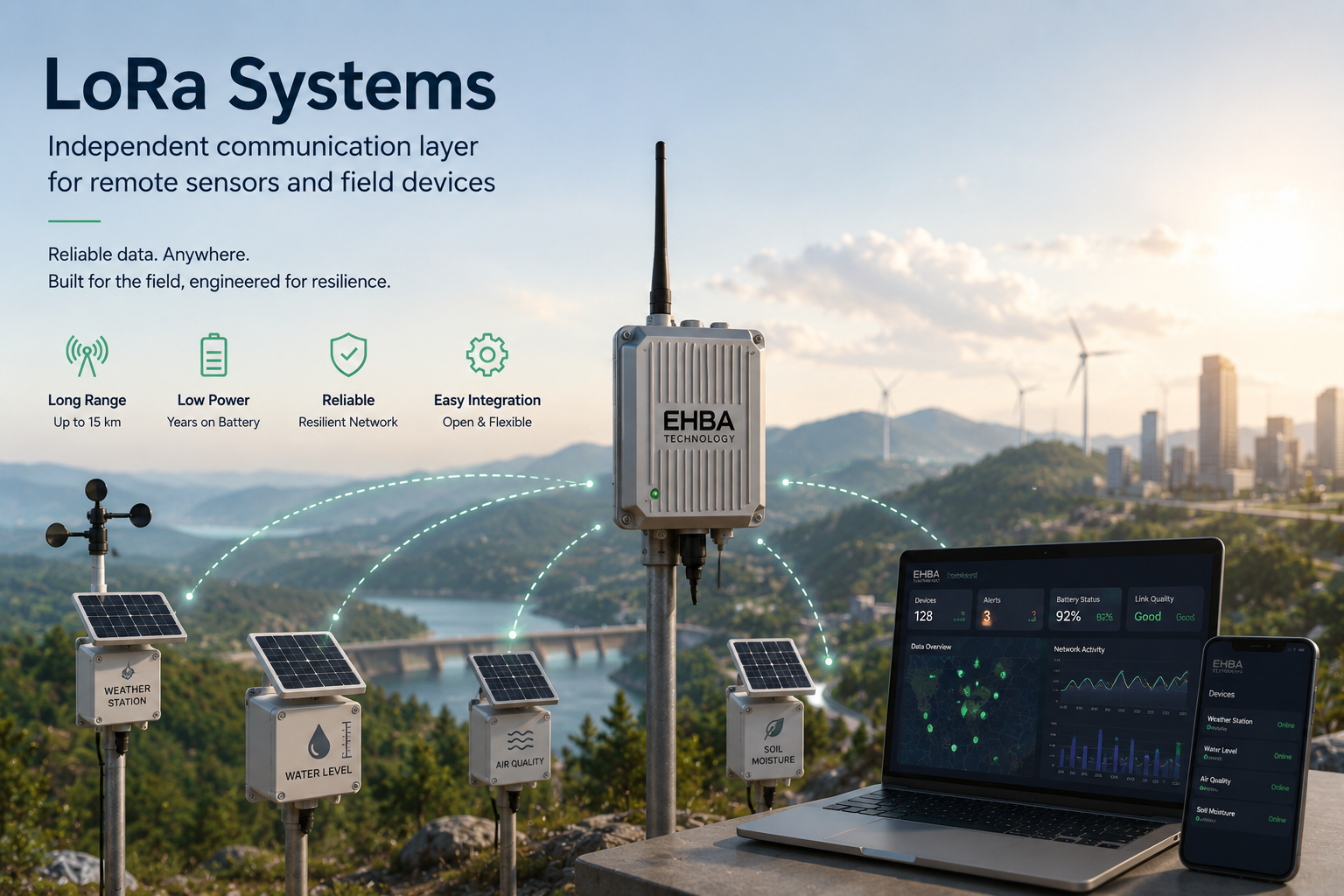
Long-range wireless
Designed for distributed field assets
Low-power operation
Suitable for battery and solar nodes
Private architecture
Dedicated device-to-gateway communication
Scalable deployment
Add nodes as monitored areas grow
Why LoRa
Field devices should not become invisible when cellular coverage ends.
Remote sensors often operate beyond reliable GSM, Wi-Fi or fibre coverage. LoRa creates a dedicated communication layer that carries small but critical data packets across long distances with low energy consumption.
Coverage gaps
Remote assets may be located outside stable cellular or fixed-network coverage.
Power constraints
Field nodes must often operate for long periods from batteries or compact solar systems.
Deployment cost
Running cables, fibre or powered repeaters across large areas may be impractical.
System Architecture
A clear path from field sensor to operational platform.
EHBA LoRa solutions can combine field nodes, gateways, local processing and cloud or on-premise software according to the requirements of each deployment.
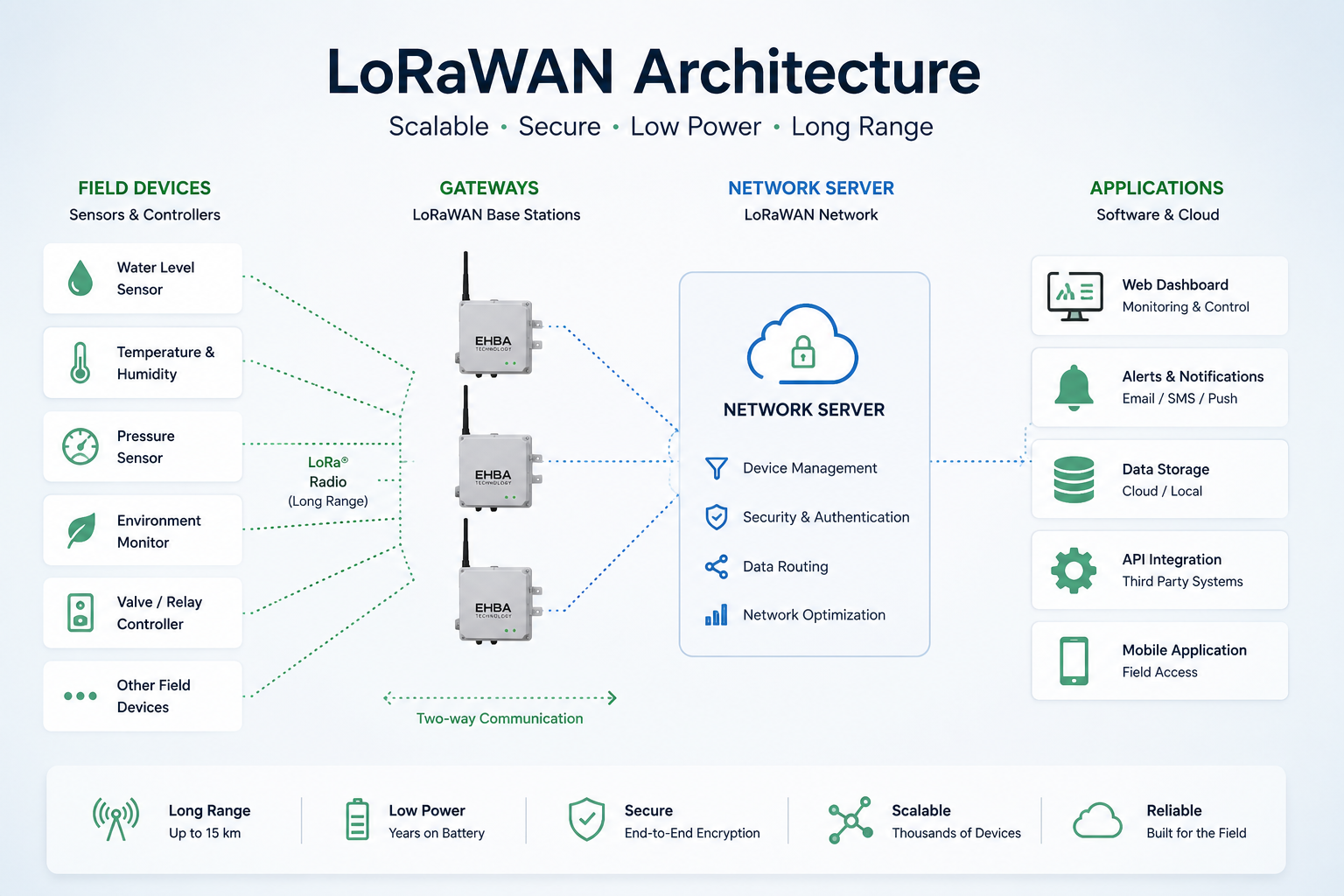
Field Nodes
Sensors, controllers, meters and embedded devices collect operational data.
LoRa Communication
Low-power radio links transfer device messages across the monitored area.
Gateway Layer
Gateways receive node traffic and forward it to local or remote software.
Monitoring Platform
Dashboards, alerts and integrations convert field data into operational awareness.
Communication Flow
Sense, transmit, evaluate and act.
Sense
A field device measures environmental or operational conditions.
Transmit
The node sends a compact message through the LoRa radio layer.
Process
The gateway and software validate, store and evaluate the incoming data.
Respond
Operators receive dashboards, status updates or threshold-based alerts.
Core Capabilities
Designed around the needs of real field operations.
Long-range connectivity
Reach remote sensors across industrial, agricultural and environmental sites.
Low energy demand
Support nodes that operate from batteries or solar-assisted power systems.
Custom field hardware
Integrate purpose-built sensor nodes, controllers and protected enclosures.
Expandable networks
Grow from pilot deployments to larger multi-zone communication architectures.
Alert automation
Generate operational notifications from sensor thresholds and event rules.
Platform integration
Connect field data with dashboards, APIs and existing automation platforms.
Deployment Areas
Environmental MonitoringWeather, fire risk, air and water data
Industrial SitesEquipment status and remote alarms
AgricultureSoil, irrigation and greenhouse sensing
UtilitiesRemote meter and infrastructure monitoring
Smart InfrastructureLighting, access and distributed assets
Disaster CommunicationIndependent low-data emergency links
One communication layer, multiple operational environments.
Every deployment can be adapted around distance, terrain, sensor type, message frequency, power availability and required software integrations.
Engineering Approach
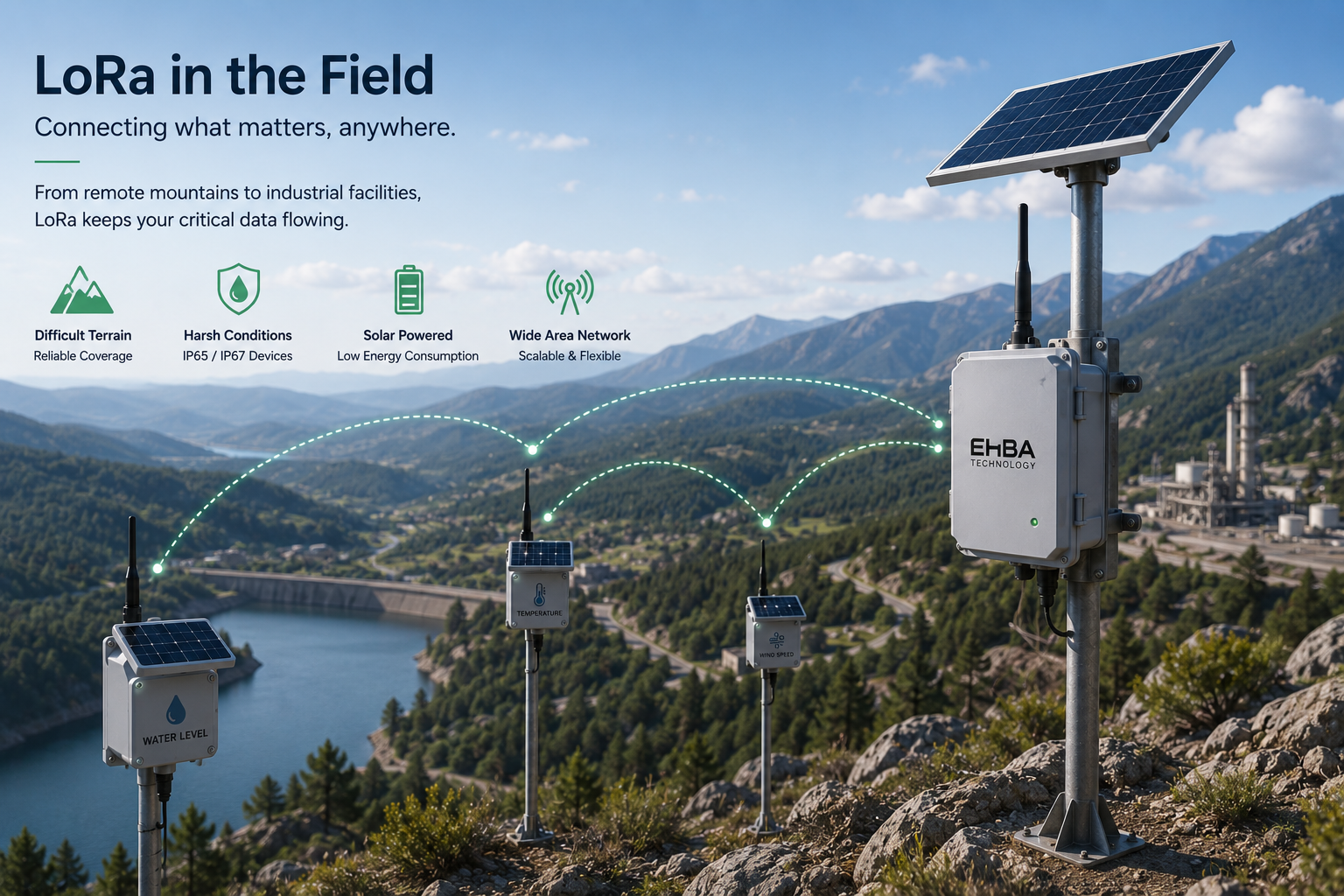
Not a generic gateway installation—a complete field communication design.
EHBA Technology evaluates terrain, radio coverage, device density, energy requirements, enclosure protection, gateway placement and software integration before defining the deployment architecture.